
You can view some members photos of the total Lunar eclipse on the morning of Monday 28th September on this gallery.

Amateur astronomy in Cheltenham, Gloucester and environs
You can view some members photos of the total Lunar eclipse on the morning of Monday 28th September on this gallery.

Cotswold AS member Neil Havard took to the sea in pursuit of the Total Solar Eclipse on March 20th – and got bonus views of the aurora on his trip.

The society held three successful observing events around Cheltenham and Gloucester, and many members were able to see this rare event.

During 2015, the Jupiter system will be edge-on to the Earth and Sun, which allows observers to see fascinating phenomena of the Galilean moons. First, this alignment allows the moons and the shadows to transit across the Equatorial Zone so that observers have the greatest chance of seeing one or more of them on the disk. Second, it allows the moons to eclipse and occult one another in so-called ‘mutual phenomena’. These events can be followed even with modest telescopes, especially mutual eclipses where one can see the rapid dimming of the eclipsed moon even if it cannot be resolved. Larger telescopes do allow the moons to be resolved, and should allow some impressive images and even videos to be obtained.
John Rogers, BAA
Tony Ireland has prepared a listing of mutual events to look out for.
You can download the PDF here.
Prompted by the request from Peter for pictures to submit to the BBC One Show’s “Jupiter spot”, Les took a sequence of web cam images of Jupiter and its moons.
Les took video images every 20 mins or so from about 7:30 until midnight, and after processing composed this excellent animation.
 Click on this picture for a bigger better view.
Note the movement of the Red Spot, and the satellites.

Society member Rik McRae managed to capture the new supernova (now designated as 2014J) recently discovered in M82, through gaps in the cloud last night.
The supernova is quite bright, around magnitude 11.7 at discovery and may be brightening, before it will inevitably dim from view.
But it should be easy to see for at least the next couple of weeks – though a small telescope will probably be needed (6″ or more).
To find M82, you can use this useful finder chart from Astronomy Now, and read more about it here.


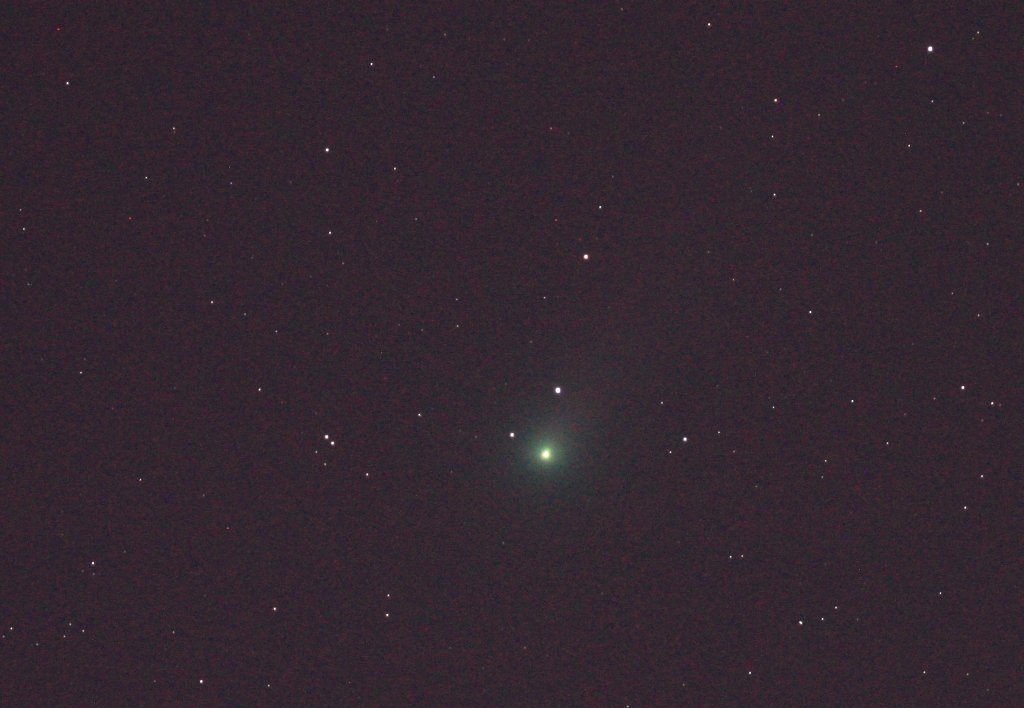
Cotswold AS member Alan Mason managed to capture both Comet 2012 S1 ISON and 2013 R2 Lovejoy this month.
Lovejoy has been a relatively accessible object, being fairly high in the morning sky.
Comet ISON has been a bit trickier, being fairly low. If there are any clear mornings this week, it may be worth trying to observe for ISON in the early morning, 30 minutes before dawn. It will be at perihelion on November 28 (and un-observable for the couple of days around this), and will probably become visible in the morning again from December 1. What will we see then ? Well we just don;t know – it could be spectacular – it could be a damp squib.The only way to be sure will be to get up early and have a look!
Last night (or this morning to be precise) a splendid display of noctilucent clouds was observed from Gloucestershire.
Cotswold AS member James Weightman captured this image from Cirencester. The bright star visible is Capella.

Details:
Lat 51.7N Long 1.9W
Time: 2013/06/03 2:00UT
Az 14 Alt 9 (by ref to Capella at this time)
Photo Canon EOS 7D + 85mm lens @ f/1.2; 0.3secs ISO 640; 2 adjacent photos merged using Photoshop.
Tony Ireland managed to capture the triple conjunction of Mercury, Venus and Jupiter shortly after the sun set on May 26th.

Mixed reports have been coming in from members who were trying to see comet C2011 L4 PanSTARRS on Wednesday March 13th.
Much of the county had fairly clear evening skies, though some low cloud and haze on the western horizon made things difficult.
Update: Picture from Ian Sibley taken at the SGL 8 astro-camp on 13th March.
